Teatime Tuesday
|
Project Type: |
Community / Social Impact |
|
Organisation: |
Collective Skills Project CIC |
|
Role: |
Co-Founder · Concept Development · Community Activation · Partnership Working · Delivery |
|
Period: |
Covid-era pilot / pop-up activation |
What happens when a community project becomes useful enough that people want to help sustain it?
Collective Skills Project CIC was created around a simple idea: People already have valuable skills. What if we created ways for those skills to be shared across the community?
The wider aim was to reduce isolation, create more opportunities for connection and bring different generations together through practical, social activity.
Teatime Tuesday emerged during Covid, when community connection and access to simple, enjoyable experiences mattered more than ever.
We collaborated with a local chef to create a series of recipes that people could cook at home.
The idea was simple: Give people everything they need to make something from scratch, and turn an ordinary meal into a shared community experience.
From recipe to experience
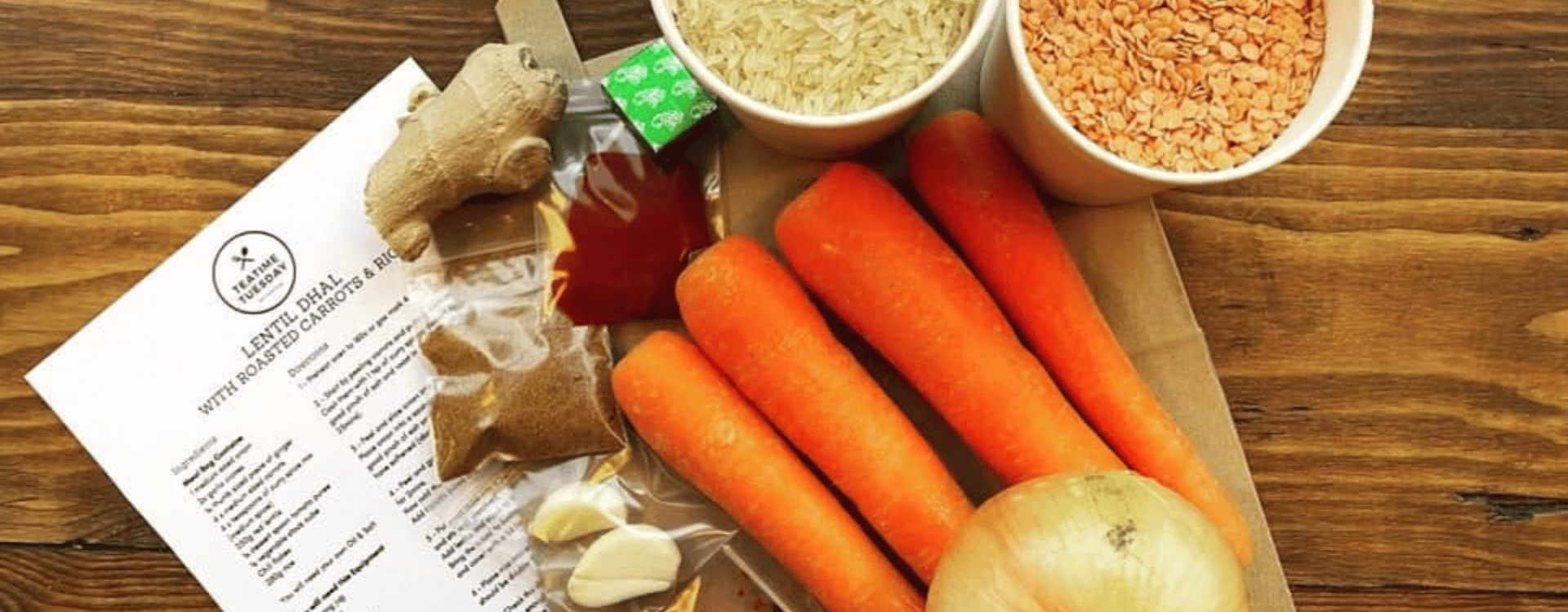
Each week, ingredients were bought in bulk and divided into individual meal kits.
Each bag contained everything required to cook the recipe at home for a family of four, including smaller ingredients such as herbs and spices that people might not already have in their cupboards.
Professionally printed recipe cards were included so people could follow the process easily.
Participants could collect their kit from a local community venue during a designated collection period, and later we also introduced home delivery so the project could reach people beyond the immediate neighbourhood and across Stoke-on-Trent.
The aim was not simply to distribute food.
It was to create a small moment of participation. Something people could make themselves. Something new to try. Something they could share.
Learning by doing
The feedback started coming back quickly.
People sent photographs of the meals they had made. They told us what they enjoyed. They talked about recipes they had never tried before.
For some, it was the first time they had cooked particular dishes, such as making a curry from scratch rather than using a ready-made sauce.
That mattered. The project was not simply helping people access ingredients. It was giving them confidence, skills and a reason to try something new.
And the recipe cards often outlived the activation itself. Even after the project ended, people told us they had kept them and were still cooking particular recipes at home.
Then the community changed the model
Something unexpected happened.
People who were not financially struggling began telling us they felt uncomfortable receiving the kits for free.
They liked the project. They wanted to take part. But they also wanted to pay. Rather than seeing that as a problem, we treated it as useful information.
It led to a simple new model: Buy One, Gift One.
Someone who could afford to pay bought their own meal kit. That payment then helped provide another kit for someone who needed it.
The model allowed people to participate without feeling that they were taking something away from someone else. And it gave people another way to contribute to the community.
The customer became part of the funding mechanism.
More than food
The most valuable part of the project was not the ingredients themselves. It was what happened around them.
People tried new things. Families cooked together. Participants shared photographs. People talked about the recipes. Some contributed financially so that somebody else could take part.
And years later, people still remember the project and ask whether something similar might return.
That kind of response tells you something. Not simply that people liked the product. They valued the experience around it.
A simple idea that grew through behaviour
Teatime Tuesday began as a practical community intervention. But the community helped shape what it became.
The original model was free distribution. Participant behaviour revealed another opportunity. People wanted to contribute.
So the model evolved. Free → participation → feedback → voluntary contribution → Buy One, Gift One
That is one of the most useful things I learned from the project: Sometimes the strongest commercial or funding model does not arrive fully formed at the beginning.
Sometimes you put something useful into the world, watch what people do with it and allow their behaviour to show you what the next version could be.
What this work demonstrates
Community Insight
Understanding a real social need and creating an accessible intervention around it.
Experience Design
Turning a practical food package into an enjoyable activity people could participate in at home.
Partnership Working
Collaborating with a local chef and community venue to create and deliver the experience.
Rapid Prototyping
Developing a workable format quickly during an unusual and fast-changing period.
Behavioural Observation
Listening to how people responded and allowing unexpected behaviour to influence the model.
Social Enterprise Thinking
Evolving a free community intervention into a simple Buy One, Gift One cross-subsidy approach.
Content & Communication
Creating clear recipe cards and materials that helped people participate independently.
Operational Delivery
Sourcing ingredients, portioning kits, coordinating collection points and later expanding into home delivery.
Community Participation
Creating something people did with us rather than something simply delivered to them.
The lesson I carry forward
People do not always want to receive. Sometimes they want the dignity and pleasure of contributing too.
Teatime Tuesday became more interesting when we stopped seeing people simply as recipients and started allowing them to become part of the model.
And perhaps the strongest proof of all is that people still talk about it. They remember the recipes. They kept the cards. And they still ask: “Are you ever bringing that back?”