When the Clock Strikes Murder
|
Project Type: |
Embedded Experience & Commercial Strategy |
|
Organisation: |
Thames Cruises London |
|
Role: |
Concept Development |
| First launched: |
2016 |
|
Status: |
Delivered and tested over multiple years |
When a successful experience returns to a different market, is it still the same commercial proposition?
In 2016, while working at Thames Cruises London, I helped create When the Clock Strikes Murder, a New Year's Eve murder-mystery dinner cruise designed to offer something different from the more conventional Thames party cruises available at the time.
The original format brought together dinner, theatre, social interaction, dancing and London's New Year's Eve fireworks in one shared experience.
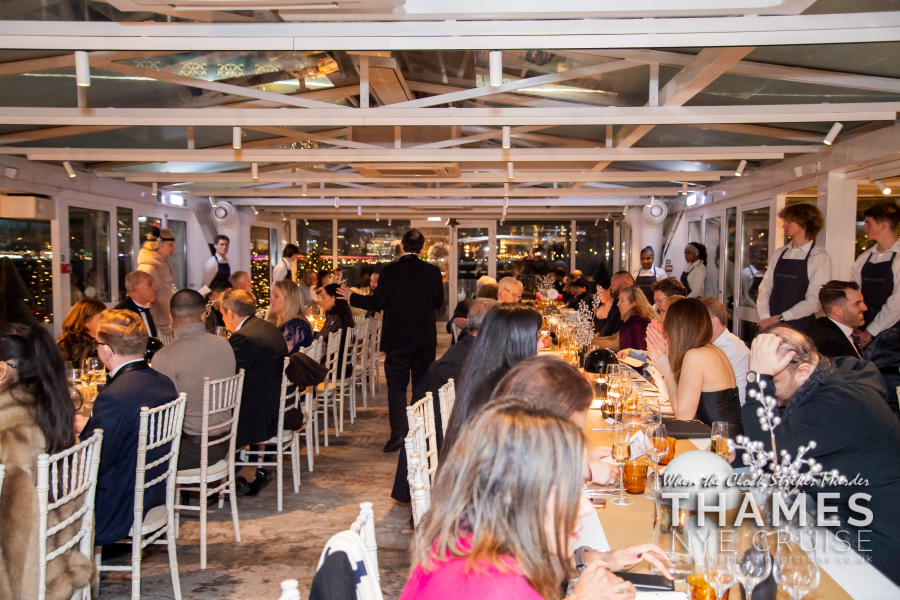
Guests were encouraged to dress in 1920s style and joined long communal dining tables while performers played out a murder mystery throughout dinner.
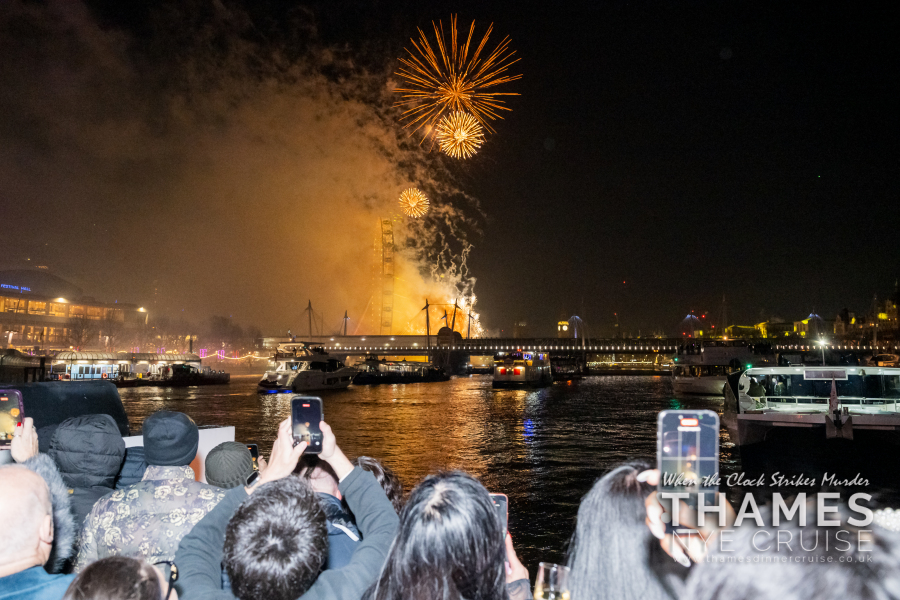
The murder was revealed after dessert, the DJ took over for dancing, and at midnight the boat moved into position for the Thames fireworks.
The ticket also included arrival champagne, dinner, drinks throughout the evening, a midnight champagne toast and photography.
THE FIRST TEST
The first cruise was deliberately relatively intimate, with capacity for around 70 guests.
69 tickets were sold at £285 per person, with the event selling out by October, more than two months before New Year's Eve.
More important than the numbers was what happened on board.
The murder mystery gave strangers an immediate reason to talk to one another. Shared tables created interaction naturally. The entertainment gave the evening a structure without overwhelming the dinner, while the fireworks provided a spectacular shared finale.
A professional photographer captured the evening, with images sent to guests afterwards as a memento and used to help tell the story of future events.
After every cruise we reviewed feedback from guests, staff and suppliers and adjusted the experience accordingly, from service flow and drinks provision to pricing and guest communications.
The format then ran successfully across subsequent New Year's Eve celebrations before Covid interrupted the series.
"People kept asking for it back"
Same idea. Very different economics.
Instead of needing approximately 70 guests, we were now working with an ambition of around 200 guests, almost three times the scale of the original event.
We bench-marked comparable New Year's Eve products, modelled the costs and built a break-even analysis before going on sale.
The new ticket price was £595 per person, reflecting the substantially increased vessel and event costs and including a five-hour cruise, four-course dinner, murder mystery, unlimited drinks, DJ, photographer and midnight champagne alongside the fireworks.
We also explored additional propositions, including a combined cruise-and-hotel stay with a nearby four-star hotel, group table incentives and distribution through external agents.
The approximate break-even point was 147 guests. The target was around 200.
But, it turned out, that actual demand settled at approximately the same level the original experience had historically supported: around 70 guests.
The experience still worked. The commercial model didn't.
The event itself remained enjoyable and guests responded positively to the core experience.
There were operational lessons including heating problems aboard the vessel on a cold December evening, but the larger issue was commercial.
Despite different sales approaches, group incentives, agent distribution and late-stage conversations with suppliers about reducing costs, demand did not reach the level required by the new economics.
We also observed that other premium, seated-dinner New Year's Eve cruises appeared to face similar challenges, while lower-priced party formats seemed to perform more strongly.
That raised a much more interesting question than simply asking whether the event had “worked” or “failed”:
Had we changed the product or had the market around it changed?
The original experience had repeatedly demonstrated demand at around 60–70 guests.
The relaunch required more than twice that number simply to break even.
At the same time, the ticket price had moved from £285 to £595 and the wider behaviour, spending power and expectations surrounding New Year's Eve had changed considerably since 2016.
We cannot attribute the result to one factor alone.
But the test suggests that the experience proposition remained attractive while the new scale, price point and cost structure no longer matched the size of the proven market for it.
What I learned
A loved experience is not automatically a scalable experience.
Past demand does not guarantee future willingness to pay.
Customer requests to “bring something back” are useful signals, but they are not the same thing as demonstrated purchasing behaviour at a new price.
And sometimes the correct commercial decision is not to force an idea to fit a larger operating model.
The original format may simply have had a natural sweet spot.
Today, I would be far more interested in finding a model that restores those economics or packaging the proven format for a private client, brand or operator who wants the experience without Thames Cruises London carrying the ticket-sales risk.
The experience worked. The experiment taught us where the commercial limits might be.
Capabilities: Experience Concepting · Commercial Strategy · Product Development · Pricing · Break-Even Modelling · Customer Experience · Event Production · Sales Strategy · Iterative Testing